SGS On-site Assessed Custom Manufacturer SGS On-site Assessed Custom Manufacturer
Choosing a reliable PU Rubber Yoga Mat supplier in China requires more than comparing catalog prices. Material quality, production consistency, and honest communication can shape every user’s experience. A mat should feel stable under sweaty palms, cushion the knees, and recover its shape after repeated rolling.
This guide introduces China’s top 10 PU Rubber Yoga Mat suppliers through practical purchasing criteria. We examine factory experience, product customization, raw material control, surface grip, rubber density, odor management, and quality inspection procedures. Certifications and test reports also matter, especially for importers serving different markets. A polished sample is useful, but it cannot replace factory audits or batch testing.
The selected suppliers may serve private-label brands, distributors, studios, and retail businesses. Their capabilities can differ widely. Some focus on premium natural rubber bases, while others offer flexible OEM colors, packaging, and logo printing. Ask for physical samples. Check the corners, stitching, surface texture, and packaging after transport. Small details reveal production discipline.
No supplier is perfect.
A ranking can never capture every buyer’s priorities. Prices, lead times, minimum order quantities, and export experience should be verified directly before signing an agreement. This article aims to provide a practical starting point, not an unquestionable verdict. Product specifications may also change over time, so responsible buyers should confirm current data with manufacturers. With careful comparison and documented communication, businesses can reduce surprises and choose a supplier that supports dependable long-term growth.
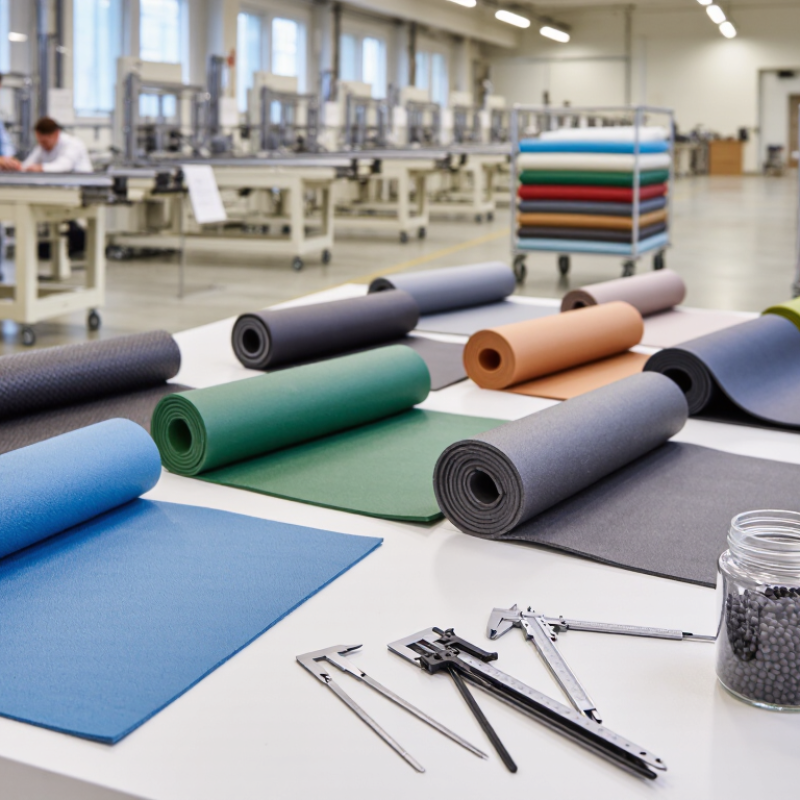
PU rubber yoga mats combine a polyurethane surface with a natural or synthetic rubber base. The PU layer feels smooth and absorbs moisture during sweaty sessions. The rubber underside helps the mat stay stable on wood, tile, or studio flooring. It also provides firm cushioning for knees and wrists. The surface is usually easy to wipe clean. Still, performance depends on bonding quality, thickness, and material formulation.
Chinese suppliers attract buyers because China has mature rubber, polymer, textile, and printing supply chains. Many factories can control mixing, calendaring, lamination, cutting, and packing in one production network. This can shorten development time and support custom sizes, textures, colors, and packaging. Experienced suppliers should provide production samples, material specifications, factory quality records, and third-party test reports. These documents make claims easier to verify.
A practical buyer should test grip with dry and damp hands. Check whether edges curl after storage. Smell the mat after opening the package. Strong odor may indicate poor formulation or inadequate airing. The material is not flawless. A softer mat may feel comfortable but wear faster under daily studio use. A very sticky surface can also collect dust. I would compare several samples before ordering, then inspect thickness, weight, surface recovery, and rubber bonding during production. Price matters, but consistent quality matters more.
| Rank | Supplier Profile | Typical PU Surface | Rubber Base | Common Thickness | Typical Size Options | Typical MOQ | Customization Capability | Common Compliance Documents | Best Suited For |
|---|---|---|---|---|---|---|---|---|---|
| 1 | High-volume OEM Manufacturer | Smooth or micro-textured Water-based PU coating is commonly specified for grip and easy cleaning. |
Natural rubber or natural-rubber-blend foam | 3–5 mm | 183 × 61 cm; custom dimensions available | Usually 300–1,000 pieces per design | Color matching, logo printing, packaging, surface texture | Material test report, REACH or RoHS testing when requested, factory quality records | Retailers and established fitness distributors |
| 2 | Premium Studio-Mat Specialist | High-grip PU top layer Designed to maintain traction during heated or high-sweat sessions. |
Dense natural rubber with a stable anti-slip base | 4–5 mm | 183 × 66 cm; 200 × 66 cm | Typically 100–500 pieces per color | Edge finishing, alignment marks, branded cartons and carry straps | Material composition declaration, abrasion test, odor assessment | Yoga studios, instructors and premium retailers |
| 3 | Eco-Focused Rubber Mat Supplier | Water-based PU finish Low-solvent or solvent-reduced production may be available by specification. |
Natural rubber; latex content should be clearly declared | 3–4.5 mm | 183 × 61 cm; 183 × 66 cm | Usually 200–800 pieces per design | Recycled-paper packaging, plastic reduction, custom hangtags | REACH testing, packaging material declaration, latex disclosure | Environmentally positioned online and specialty retailers |
| 4 | Private-Label Export Factory | Printed or solid-color PU Suitable for private-label collections and coordinated color ranges. |
Natural rubber or synthetic-rubber blend | 3–6 mm | Standard and retail-specific formats | Often 500–2,000 pieces per artwork | Artwork adaptation, barcode labels, instruction cards and retail packaging | Pre-shipment inspection, carton specifications, product test reports | Importers, marketplaces and private-label brands |
| 5 | Custom-Size Commercial Supplier | PU coating with configurable texture Texture selection affects grip, cleaning and tactile feel. |
Rubber base engineered for dimensional stability | 4–8 mm | Custom lengths and widths; standard sizes also available | Typically 100–500 pieces, depending on size | Custom dimensions, corner radius, logo placement and packing method | Dimensional inspection, weight tolerance, slip-resistance test | Hotels, gyms and wellness facilities |
| 6 | Mid-Market Value Supplier | Standard PU surface Balanced for everyday grip, appearance and cost control. |
Rubber-blend base with moderate cushioning | 3–5 mm | 173–183 cm length; 61–66 cm width | Often 300–1,000 pieces | Basic colors, one-color logos, standard packaging | Basic material declaration and production inspection records | Entry and mid-range product lines |
| 7 | Small-Batch Flexible Manufacturer | Plain or lightly textured PU More suitable for limited collections than extensive artwork programs. |
Natural rubber or rubber blend, subject to availability | 3–5 mm | Common standard sizes; limited custom sizing | Approximately 50–300 pieces per color | Small-run colors, simple logos and limited packaging changes | Sample approval records, basic QC checklist and material declaration | Start-ups, boutique studios and product testing |
| 8 | Textured-Grip Performance Supplier | Micro-textured PU Texture is selected to improve hand and foot traction without deep grooves. |
High-density rubber base | 4–6 mm | 183 × 61 cm; 183 × 66 cm | Usually 200–800 pieces | Texture pattern, logo placement, color and strap customization | Slip-resistance testing, abrasion testing and dimensional inspection | Dynamic yoga, Pilates and fitness training |
| 9 | Travel and Lightweight Mat Supplier | Thin PU-coated surface Optimized for reduced weight and easier folding or rolling. |
Thin rubber layer or lightweight rubber blend | 1.5–3 mm | 173–183 cm × 61 cm | Typically 300–1,000 pieces | Carry straps, travel bags, folding formats and compact cartons | Weight specification, fold-recovery check and material declaration | Travel products, mobile instructors and online sales |
| 10 | Integrated Mat and Accessory Supplier | PU surface with coordinated accessories Mat design can be matched with straps, bags, towels or blocks. |
Natural rubber or rubber-blend construction | 3–6 mm | Standard sizes plus selected custom formats | Usually 300–1,000 complete sets | Bundled products, gift boxes, inserts and multi-item packaging | Product-level test reports, packaging inspection and carton drop testing | Gift sets, subscription boxes and complete yoga programs |
Data shown are typical China-market sourcing ranges and product specifications for PU rubber yoga mats, not company-specific claims. Actual MOQ, materials, testing documents, lead time and customization options should be confirmed with each supplier before purchase. Natural rubber may contain latex and is not suitable for people with latex sensitivity.
Check the rubber base, PU surface, thickness, weight, odor-control process, and export experience. Request factory photos, test reports, and physical samples.
Test the surface with dry and damp hands. A stable mat should resist sliding during simple movements. Test both conditions.
Two batches may reveal differences in color, thickness, grip, or surface texture. One sample can create false confidence.
Standard PU rubber mats often cost about USD 8 to USD 22. Thickness, texture, printing, and packaging affect the final quotation.
Ask whether edge finishing, cartons, export documents, and shipping charges are included. Small details change the landed cost.
Standard colors may require 300 to 1,000 pieces. Custom colors, logos, and packaging may require larger quantities.
Customization can increase the MOQ, unit price, and production time. Confirm artwork approval and delivery dates in writing.
Request carton dimensions, loading photos, shipping timelines, and HS-code guidance. Confirm FOB, CIF, or door-to-door options.
Ask for moisture-resistant cartons and strong corner protection. Request a pre-shipment inspection. Polished quotations can still hide weak packaging.
Yes. A first sample may show uneven color or slight measurement differences. Discuss acceptable limits before production. I may still miss small defects.
This guide explores what makes a PU Rubber Yoga Mat a popular choice for yoga studios, fitness centers, and private-label retailers. Combining a grippy polyurethane surface with a resilient rubber base, these mats can provide reliable traction, cushioning, durability, and easier maintenance. Chinese suppliers are often considered because they offer broad manufacturing capacity, flexible customization, competitive pricing, and export experience. The article explains how to evaluate suppliers through factory capabilities, material consistency, quality-control procedures, communication, production timelines, and customer support.
It also presents a practical comparison framework for China’s top 10 PU Rubber Yoga Mat suppliers without focusing on brand names. Readers will learn how to review product specifications, safety and environmental certifications, logo and packaging customization, color choices, thickness options, and sample policies. Additional guidance covers comparing unit prices, minimum order quantities, shipping arrangements, payment terms, lead times, and export services, helping buyers select a dependable partner that matches their quality standards, budget, and market requirements.